The Cambridge Companion to Gadamer by Robert J. Dostal
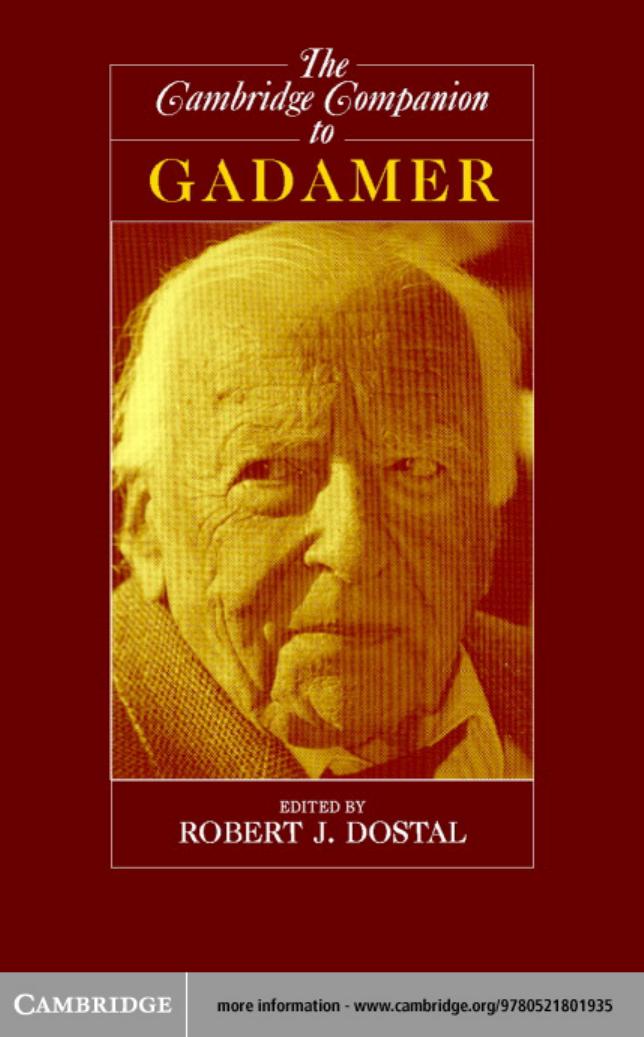
Author:Robert J. Dostal
Language: eng
Format: epub, pdf
Publisher: Cambridge University Press
IV
That poetry since Hegel has become a more inward art coincides with the severance of poetry from the discourse of religion and myth. This severance has undeniably resulted in a poetry more modest in its claims on public attention. Paradoxically, however, it has also resulted in a poetry more radical in its purchase upon the world. Not the least of Gadamer’s contributions is his detection in Rilke, a poet surely ignorant of Hegel, of an answer to the Hegelian prophecy on the future of art that is simultaneously a speculative working out of that prophecy.
In his essay “On the Contribution of Poetry to the Search for Truth” Gadamer draws the connection between poetry’s speculative relevance and the concept of world. There he links poetry to an Einhausung, or making oneself at home, specifying though that what appears in the poem “is not the world nor this or that thing in the world” (RB 115). This passage is worth pausing over on account of Gadamer’s very careful phrasing. For Gadamer actually distinguishes the moment of poetic showing from this process of sharing a world. He says in fact that poetry stands over against this process, “like a mirror held up to it” (RB 115). This is a most telling choice of words. What Gadamer means here is not, as the words quoted already attest, that poetry reproduces the appearances of the world. On the contrary, the mirroring that poetry does has the sense of speculation that Gadamer first examined in the final part of Truth and Method. Poetry is speculative discourse in that standing over against the world it opens up to us the “nearness or familiarity” in which something like a world can be first be experienced and become the object of sharing. Poetic language is in this “eminent” sense language: it discloses not a world so much as the being of world, the phenomenon of worldliness. It is this feature of poetic language that keeps it in the neighborhood of speculative language. This naturally does not mean that there are no criteria for establishing poetic worth. What a poem offers may turn out to be hollow – as Gadamer says, it may merely sound like poetry, be a mere echo of poetry. But as poetic discourse it is not, in itself, falsifiable (RB 139).
Moreover, this articulation of experience is never sufficient to it-self, but instead always intends something beyond itself: “Everything that goes under the name of language always refers beyond that which achieves the status of a proposition” (DD 25). This idea is implicit to all great poetry but it has received a particular relevance in the modern poetry of, say, Hölderlin, Mallarmé, T. S. Eliot, and Paul Celan, where what is said is crafted from the beginning as fragmentary utterance. This gives rise to the paradoxical but thoroughly consistent hermeneutic tenet that when we do not understand what is said in the poetic text, we must return to the text itself. Returning to the text, though, is
Download
The Cambridge Companion to Gadamer by Robert J. Dostal.pdf
This site does not store any files on its server. We only index and link to content provided by other sites. Please contact the content providers to delete copyright contents if any and email us, we'll remove relevant links or contents immediately.
| Anthropology | Archaeology |
| Philosophy | Politics & Government |
| Social Sciences | Sociology |
| Women's Studies |
The remains of the day by Kazuo Ishiguro(8998)
Tools of Titans by Timothy Ferriss(8393)
Giovanni's Room by James Baldwin(7346)
The Black Swan by Nassim Nicholas Taleb(7129)
Inner Engineering: A Yogi's Guide to Joy by Sadhguru(6793)
The Way of Zen by Alan W. Watts(6614)
The Power of Now: A Guide to Spiritual Enlightenment by Eckhart Tolle(5781)
Asking the Right Questions: A Guide to Critical Thinking by M. Neil Browne & Stuart M. Keeley(5775)
The Six Wives Of Henry VIII (WOMEN IN HISTORY) by Fraser Antonia(5515)
Astrophysics for People in a Hurry by Neil DeGrasse Tyson(5189)
Housekeeping by Marilynne Robinson(4446)
12 Rules for Life by Jordan B. Peterson(4304)
Ikigai by Héctor García & Francesc Miralles(4274)
Double Down (Diary of a Wimpy Kid Book 11) by Jeff Kinney(4268)
The Ethical Slut by Janet W. Hardy(4251)
Skin in the Game by Nassim Nicholas Taleb(4248)
The Art of Happiness by The Dalai Lama(4130)
Skin in the Game: Hidden Asymmetries in Daily Life by Nassim Nicholas Taleb(4004)
Walking by Henry David Thoreau(3962)
